As Soon as the Money Changes Hands: Understanding the Metaphor We're Living


Part 2/3
Delroy Lindo sat across from a journalist and stripped the vampire down to its essence: "If you look at what is a vampire — what is an entity that sucks from others for themselves?"
The journalist said it: "Capitalism."
Delroy's response was careful, diplomatic even: "You're saying that. But what I am saying is it's very very contemporary. Any entity that sucks from any other entity for its own use, any entity that says 'I see you but I can't appreciate you. No, I have to take from you. And if taking from you involves destroying you, then...'"
He didn't finish the sentence. He didn't have to.
In Part 1 of this series, we excavated the inheritance: the blues, the church-to-juke joint pipeline, the ancestral magic they taught us to fear. We established what we brought with us from Africa, what we created in the American South, what they tried to make us forget.
Now we need to talk about what they did to that inheritance. What they're still doing. Right now. Today.
Because here's the thing about Sinners that makes it so devastatingly relevant: it's not a period piece. Yes, it's set in 1930s Mississippi. Yes, the vampires are literal. But strip away the genre dressing and you're looking at a mirror. You're looking at exactly what's happening to Black creators, Black communities, and Black culture in 2026.
Ryan Coogler made a vampire film to talk about extraction. And once you see that, you can't unsee it.
That Same Day
Let me take you back to November 17, 2021. Ryan Coogler is standing in that cotton field in Byron, Georgia. He's in the middle of making Black Panther: Wakanda Forever: a production that had become a four-year nightmare. The pandemic shut them down. Chadwick Boseman, their lead actor and Ryan's friend, had died. Leticia Wright had been injured on set. The weight of it all was crushing.
Ryan gets out of the car. Walks into the field. Feels the overwhelming guilt of proximity and distance—ancestors 100 years removed, ancestors 400 years removed, and he'd never been here. Never stood where they stood. Never touched what they touched.
He takes something from that field. A piece of cotton. A piece of evidence.
And that same day—the same day he's grappling with ancestral trauma and the extractive violence of the entertainment industry grinding him down—he hears that Young Dolph has been murdered in Memphis.
"I had never met this dude. I had never met Nip," Ryan said. "But I felt like I knew him from the music."
And that's when something broke open in him.
A Lifetime of Losing Artists
Ryan is from Oakland. He was going to football practice with his friends the day Tupac died. The entire practice shut down. Coaches crying. Mothers crying. Kids who'd never met Pac feeling like they'd lost family.
He was in Philadelphia making Creed when he heard The Jacka got killed. When Keak Da Sneak got shot in the back and paralyzed. He watched his friends who were trying to make it in rap get taken out before they could even get on.
"As a fan of his music bro," Ryan said, "it's been a lifetime of this shit."
A lifetime of watching Black men create something beautiful and powerful, succeed at it, reach their thirties, forties, fifties — and still fall victim. Still get taken out. Still have their lives cut short by violence.
And he couldn't listen to it anymore. He told his producer Nate Moore: "Man, what kind of music is there where the artist talks about how to navigate where they from, how to escape all the demons they dealing with, they succeed, get to their 30s and still fall victim to this shit bro? What music exists like this?"
Nate, who's from Central California, thought about it. "Man, grunge music. We just lost Chris Cornell, bro. He was in his 50s. All they music is about struggling with demons, depression, trying to kick dope. They end up, they get all the money in the world and they're dying in hotel rooms."
Ryan started listening to grunge. Nirvana, Soundgarden, Pearl Jam. And he realized something that shifted everything.
"Man this shit sound like what my uncle used to play. I was listening to the guitar riffs and what they talking about and the passion they sing with. I dug into the research man and that's exactly what it is. It's just blues music sung by white people."
The blues never stopped. It just got repackaged. Renamed. Whitened. And even then, even when white people were playing it, the system still killed them. Because the system doesn't just extract from Black people: it extracts from everyone. We're just the ones who invented the form. We're the ones it was stolen from first.
Three Layers of Property
In his research, Ryan kept finding the same pattern: music that was meant to be communal getting turned into property.
"The moment you start trying to sell it," Ryan explained, "we already are putting the concept of ownership and transfers and we now turning like a system of healing into property. And we doing it to a people that have been turned into property. On land that was someone else's land that has now been turned into property."
Three layers. Music turned into property. People turned into property. Land turned into property.
And all of it starts with that first transaction: when the healing stops being healing and starts being product. When community wealth becomes individual commodity. When the thing that was meant to connect us to the ancestors becomes the thing that someone else can own and sell.
"They Were Fucked Before the Vampires"
In Sinners, there's a scene involving plantation tokens: company scrip that sharecroppers were paid in, currency that could only be used at the company store. It's a closed economic loop designed to keep people perpetually indebted, perpetually trapped.
A journalist interviewing Ryan identified something crucial: "The minute they kind of lose is when they seek the white man's money, right?"
Ryan didn't explicitly confirm this on the record; he's smart enough to let the work speak for itself. But the film makes it clear. The moment they accept those tokens, the moment they enter into that economic system, they've already lost.
The journalist pushed: "What if the vampires didn't show up? What happens to those people?"
Ryan's answer was devastating: "Everybody at that juke was going to be dead anyway. They were fucked before [the vampires]. They were fucked the moment they bought the mule."
Read that again. They were fucked the moment they bought the mule.
The vampires aren't the real threat. The system already had them marked for death. The vampires just sped up what was always going to happen.
And if you think that's just about the 1930s, you're not paying attention.
From Cotton Fields to Streaming
Let me bring this to right now. 2025.
Black artists dominate the charts. Dominate culture. Set the trends that everyone else follows six months later. And yet: who owns the masters? Who owns the publishing? Who controls the platforms? Who decides what gets promoted, what gets suppressed, what gets monetized?
Drill music gets criminalized. Rappers get their lyrics used against them in court as evidence. Young Black men make money from their art and immediately become targets — either for the streets or for the system that wants to lock them up.
Meanwhile, white artists sample our music, imitate our aesthetics, profit from our innovations— and face none of the violence, none of the criminalization, none of the consequences.
Record labels sign Black artists to 360 deals that extract every possible revenue stream. Streaming services pay fractions of pennies per play while the executives get rich. Social media platforms build billion-dollar companies off Black cultural production while Black creators fight for scraps.
That's extraction. That's vampirism. The mechanism has changed but the dynamic is exactly the same:
I see you,
I see your magic,
I see your creativity, and
I can't just appreciate it.
I have to take it.
I have to own it.
And if you die in the process? That's just the cost of doing business.
The Mulatto Character and Proximity Without Protection
There's a character in Sinners named Mary, played by Haley Steinfeld. She's visibly white-presenting, but the implication is that she's maybe one-eighth Black. And throughout the film, she shows up to Black celebratory spaces demanding to be let in.
She wants access. She wants to be part of the magic. She wants to be enveloped in the richness of the Black community that she's adjacent to, but not actually part of.
And the film shows, again and again, that letting her in is what undermines the community.
Blue Telusma watched this film and said: "We need to stop inviting every fucking body to the cookout just because they know how to do the Dougie." This isn't about being mean. This isn't about being exclusionary for the sake of it. This is about gatekeeping as survival.
Blue told a story that connects directly to this. In 2014-2015, when Black Lives Matter was taking off and her career in digital media was blowing up, CNN tried to hire her. Her mother warned her: "Be careful, Blue. I don't want you accepting this job because you are too honest. Those white folks will kill you for your mouth."
Blue turned down the job. And then she watched Marc Lamont Hill—someone who speaks truth to power the way she does—get fired from CNN for speaking too loudly, for refusing to soften his analysis, for doing exactly what Blue would have done.
"Watching CNN fire him felt like a vindication for my mother," Blue said.
The Mary character in Sinners is that same dynamic. She's proximity without protection. She's access without accountability. And when things go wrong, when the vampires come, whose side is she really on? Where does her allegiance actually lie?
We keep learning this lesson the hard way: not everyone who wants in actually has our best interests at heart. Sometimes the person knocking at the door looks like us, sounds like us, claims connection to us, but when it counts, when the real danger shows up, they fold. Or worse, they were working with the vampires all along.
When Cornbread Doesn't Feel Like Cornbread Anymore
But here's where Sinners gets even more uncomfortable: sometimes the danger isn't the white woman at the door. Sometimes it's Cornbread.
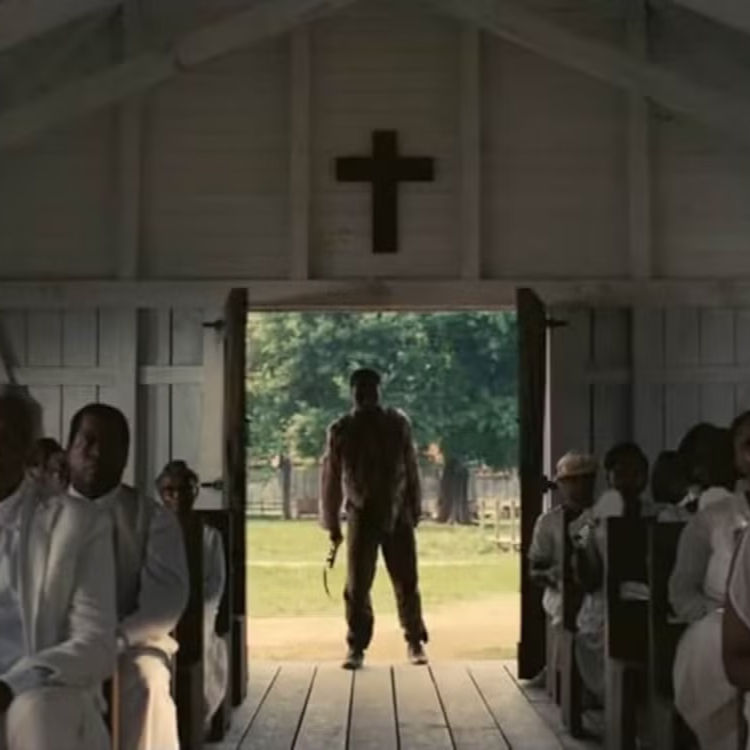
In the film, there's a scene where Cornbread—big, tall, familiar Cornbread who everyone has known his entire life—shows up at the barn door at night. He is family. He is skin folk and kinfolk. And yet something's different. Something's off.
Their first instinct is to pause. But then they start to override that instinct because it's Cornbread. How could Cornbread be a threat?
And it's the root worker—the Black witch, the spiritual one, the one still connected to intuition—who says: "Hold on. Something's not right."
Blue Telusma connected this to her own life in a way that broke her open on camera. She had a best friend for twenty-four years. Twenty-four years. They were so close she called him her "gay husband." Very Will and Grace, very codependent, very ride-or-die.
Until one day, after Blue had done years of healing work and her life had elevated significantly — moved to California, running a whole department at The Grio, making more money in a month than she used to make in a year — she had a conversation with him where she stopped hearing him through the lens of familiarity and started hearing him objectively.
"I was like, 'This man doesn't mean me well,'" Blue said.
It took her weeks to realize that he meant her harm. Not because he didn't love her. But because envy had crept into his spirit despite their twenty-four years of history.
"You could know somebody and love somebody your entire life," Blue said. "The minute you feel that they are unsafe, there's nothing honorable about letting all these years be an excuse for you not to protect yourself and listen to your instincts."
She cut him off. She fired him from the company where he'd been working under her, where she'd given him a raise, where she'd brought him into the world she'd built with her bare hands. After he quit, she found out he'd been sabotaging her relationships the entire time. Spreading poison. Undermining her. And people believed him because he was her best friend of twenty-four years.
"The fact that my biggest op was my best friend of 24 fucking years," Blue said.
That's the Cornbread scene. That's what the film is asking you to interrogate: Are the people you've known your whole life still safe? Or has something changed? Has envy crept in? Has resentment taken root? Has your success, your light, your refusal to stay small made them want to dim you?
And more importantly: are you willing to listen to your instincts even when familiarity tells you to ignore them?
The Four-Year Grind That Almost Broke Him
I want to be specific about what Ryan went through making Black Panther: Wakanda Forever because it's essential context for understanding Sinners.
The sequel to Black Panther was supposed to be joyful. A celebration. A continuation of something that had changed the culture. Instead, it became four years in Atlanta dealing with:
Pandemic shutdowns
Chadwick Boseman's death (having to refigure the entire film around that loss)
Leticia Wright's injury (more shutdowns)
More pandemic shutdowns
The weight of holding it together for everyone else while privately grieving
Four years of extraction. Because let's be honest about what the Marvel machine is: it's extraction at industrial scale. They take brilliant Black filmmakers and brilliant Black actors, and they extract every ounce of creativity, every ounce of energy, every ounce of cultural cache they can get. And when you're empty, when you've got nothing left to give, they'll find someone else.
And through it all, Ryan was listening to music to survive. Nipsey Hussle's Victory Lap on repeat during a road trip up Highway 1 with his wife. Young Dolph. Artists who'd been taken from us but whose music still conjured them. Still made them present.
"When you listen to somebody," Ryan said, "you feel like you know him, bro."
Music as conjuring. Music as presence. Music as the thing that keeps the dead with us.
But also: music as the thing that gets extracted.
Music as the thing that becomes one more way to make money off Black death. Nipsey's music sells more after he's murdered. Dolph's catalog gets streamed more after he's killed.
The system profits from our grief.
Another filmmaker, Cal-Matic, watched Sinners and told Ryan: "Seeing them two dudes, it felt like Nip and Ermias." (Ermias is Nipsey's government name, his family name, the name his mother gave him.)
Ryan wasn't consciously thinking about Nipsey when he created the twin characters Smoke and Stack. But Cal-Matic saw it anyway. Because it's there. The film is haunted by all the brothers we've lost.
All the artists who made it out of the hood, made the music, succeeded, and still got taken.
What They're Doing Right Now, Today, This Minute
Black culture is still being extracted. Black music is still being turned into property. Black artists are still dying young. Black creators are still having their work stolen, repackaged, whitewashed, and sold back to us.
TikTok dances created by Black teenagers get co-opted by white influencers who get the brand deals. AAVE becomes "internet slang" and gets monetized by people who'd cross the street if they saw us coming. Our trauma gets turned into content. Our joy gets commodified. Our pain gets packaged and sold.
And we're tired.
Blue Telusma said something that captures this moment perfectly: "We've been so under attack since Trump became president. I didn't realize how much I needed this reminder."
The reminder that our magic is real. That our instincts are valid. That gatekeeping isn't mean: it's necessary. That familiarity doesn't equal safety. That sometimes the people who claim to love us are the ones draining us dry.
Sinners is a horror film. But the real horror is that we're living it. The vampires are real. They're just wearing different faces.
The vampires are the record labels. The vampires are the streaming platforms. The vampires are the brands that want our aesthetic without our people. The vampires are the systems that profit from our death. The vampires are the people who've been in your life for decades, but whose envy finally outweighs their love.
And the question isn't whether they're coming for us; they're already here, they've always been here.
The question is: Are we finally ready to stop inviting them in?
Until next time,
Tricky Sol
In Part 3, we'll talk about what we do with this knowledge. Because naming the problem is only the first step. The real work is building the renaissance in the midst of crisis. And that's exactly what's happening right now—artists like Ryan Coogler refusing to let the extraction continue without a fight. We're making the art that responds to this moment. And that art? That's what Part 3 is about.
Sources & Further Research
This essay draws from the same interview sources as Part 1, with additional emphasis on:
Ryan Coogler interview with The Breakfast Club - The cotton field story, Young Dolph's death, discussion of grunge music revelation, Nipsey Hussle's impact, and the four-year Black Panther: Wakanda Forever production ordeal.
Delroy Lindo interview with Face Magazine - The vampire as extractive entity metaphor, capitalism discussion without explicitly naming it, and analysis of what it means to "take from you and destroy you in the process."
Ryan Coogler interview with unidentified journalist - "As soon as the money changes hands" analysis, the plantation tokens scene, and the devastating "they were fucked before the vampires" revelation.
Blue Telusma Instagram Live - The Mary character/cookout access analysis, gatekeeping as survival strategy, the 24-year best friend betrayal story, CNN/Marc Lamont Hill comparison, and the Cornbread scene as metaphor for misplaced trust.
Cast & Crew Panel - Background on the production challenges and Cal-Matic's observation about the twin characters evoking Nipsey and Ermias.
For those wanting to explore the ongoing extraction of Black culture, look into: the criminalization of drill music and use of rap lyrics as criminal evidence, the history of 360 deals in the music industry, economic disparities in streaming payouts, cultural appropriation and the "Black creativity to white profit" pipeline, and the phenomenon of increased catalog sales/streams after an artist's death.


Comments